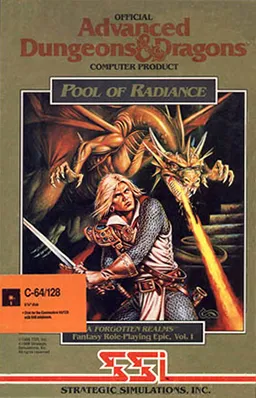
1988 · SSI
Pool of Radiance
The original Gold Box epic — reclaim Phlan
Pool of Radiance is a role-playing video game developed and published by Strategic Simulations, Inc (SSI) in 1988. It was the first adaptation of TSR’s Advanced Dungeons & Dragons (AD&D) fantasy role-playing game for home computers, becoming the first episode in a four-part series of D&D computer adventure games. The other games in the “Gold Box” series used the game engine pioneered in Pool of Radiance, as did later D&D titles such as the Neverwinter Nights online game. Pool of Radiance takes place in the Forgotten Realms fantasy setting, with the action centered in and around the port city of Phlan.
Just as in traditional D&D games, the player starts by building a party of up to six characters, deciding the race, gender, class, and ability scores for each. The player’s party is enlisted to help the settled part of the city by clearing out the marauding inhabitants that have taken over the surroundings. The characters move on from one area to another, battling bands of enemies as they go and ultimately confronting the powerful leader of the evil forces. During play, the player characters gain experience points, which allow them to increase their capabilities. The game primarily uses a first-person perspective, with the screen divided into sections to display pertinent textual information. During combat sequences, the display switches to a top-down “video game isometric” view.
Generally well received by the gaming press, Pool of Radiance won the Origins Award for “Best Fantasy or Science Fiction Computer Game of 1988”. Some reviewers criticized the game’s similarities to other contemporary games and its slowness in places, but praised the game’s graphics and its role-playing adventure and combat aspects. Also well-regarded was the ability to export player characters from Pool of Radiance to subsequent SSI games in the series.
Gameplay
Pool of Radiance is based on the same game mechanics as the Advanced Dungeons & Dragons rule set. As in many role-playing games (RPGs), each player character in Pool of Radiance has a character race and a character class, determined at the beginning of the game. Six races are offered, including elves and halflings, as well as four classes (fighter, cleric, magic-user, and thief). Non-human characters have the option to become multi-classed, which means they gain the capabilities of more than one class, but advance in levels more slowly. During character creation, the computer randomly generates statistics for each character, although the player can alter these attributes. The player also chooses each character’s alignment, or moral philosophy; while the player controls each character’s actions, alignment can affect how NPCs view their actions. The player can then customize the appearance and colors of each character’s combat icon. Alternatively, the player can load a pre-generated party to be used for introductory play. These characters are combined into a party of six or less, while leaving two open slots to add NPCs. Players create their own save-game files, assuring their characters can continue regardless of events in the game. The MS-DOS version can be copied to the hard drive. Other computer systems, such as the Commodore 64, require a separate disk for saved games.
The game’s exploration mode uses a three-dimensional first-person perspective, with a rectangle in the top left of the screen displaying the party’s current view; the remainder of the screen displays text information about the party and the area. During gameplay, the player accesses menus to allow characters to use objects; trade items with other characters; parley with opponents; buy or sell items or pool the characters’ money; cast magic spells, and learn new magic skills. Players can view characters’ movement from different angles, such as an aerial view. The game uses three different versions of each sprite to indicate differences between short-, medium-, and long-range encounters.
In combat mode, the screen switches to a top-down perspective with dimetric projection, where the player chooses what actions the characters will take in each round; these actions occur immediately, instead of happening after all commands are issued as is standard in some RPGs. Optionally, the player can let the computer choose character moves for each round. Characters and monsters may make an extra attack on a retreating enemy that moves next to them. If a character’s hit points (HP) go below zero, another character must bandage the wounded character to prevent their death. The game contains random encounters, and game reviewers for Dragon magazine observed that random encounters seem to follow standard patterns of encounter tables in pen and paper AD&D game manuals. They also observed that the depictions of monsters confronting the party “looked as though they had jumped from the pages of the Monster Manual”.
Different combat options are available to characters based on class: fighters can use melee or ranged weapons; magic-users can cast spells; thieves are able to “back-stab” opponents by strategically positioning themselves. As fighters progress in level, they can attack more than once in a round, and they also gain the ability to “sweep” enemies, effectively attacking each nearby low-level creature in the same turn. Magic-users and clerics are allowed to memorize and cast a set number of spells each day, and cast spells must be memorized again before reuse; this process requires all characters to rest in a camp for several hours, which also restores lost hit points to damaged characters. This chore of memorizing spells each night significantly added to the amount of game management required by the player.
As characters defeat enemies, they gain experience points (XP). After gaining enough XP, the characters “train up a level” to become more powerful. This training is purchased in special areas within the city walls. In addition to gaining new spells from training, mages can increase their spells known by transcribing spells from scrolls that they find in unsettled areas. Defeated enemies in these areas also contain items such as weapons and armor, which characters can sell to city stores.
Plot
The ancient trade city of Phlan has fallen into impoverished ruin. Now only a small portion of the city remains inhabited by humans, who are surrounded by evil creatures. To rebuild the city and clean up the Barren River, the city council of New Phlan has decided to recruit adventurers to drive the monsters from the neighboring ruins. Using bards and publications, they spread tales of the riches waiting to be recovered in Phlan, which draws the player’s party to these shores by ship.
At the start of the game, the adventurers’ ship lands in New Phlan, and they receive a brief but informative tour of the civilized area. They learn that the city is plagued with a history of invasions and wars and has been overtaken by a huge band of humanoids and other creatures. Characters hear rumors that a single controlling element is in charge of these forces. The characters begin a block-by-block quest to rid the ruins of monsters and evil spirits.
Beyond the ruins of old Phlan, the party enters the slum area—one of two quests available right away to new parties. This quest involves the clearing of the slum block and allows a new party to quickly gain experience. The second quest is to clear out Sokol Keep, located on Thorn Island. This fortified area is inhabited by the undead, which can only be defeated with silver weapons and magic. The characters’ adventure is later expanded to encompass the outlying areas of the Moonsea region. Eventually, the player learns that an evil spirit named Tyranthraxus, who has possessed an ancient dragon, is at the root of Phlan’s problems. The characters fight Tyranthraxus the Flamed One in a climactic final battle.
Setting
Pool of Radiance takes place in the Forgotten Realms fantasy world, in and around the city of Phlan. This is located on the northern shore of the Moonsea along the Barren River, between Zhentil Keep and Melvaunt. The party begins in the civilized section of “New Phlan” that is governed by a council. This portion of the city hosts businesses, including shopkeepers that sell holy items for worshippers at each temple, a jewelry shop, and retailers who provide arms and armor. A party can also contract with the clerk of the city council for various commissions; proclamations posted on the walls within City Hall offer pieces of useful information in the form of coded clues which can be deciphered using the included Adventurer’s Journal.
Phlan has three temples, each dedicated to different gods. Each temple can heal wounded, poisoned, or afflicted characters, and can restore deceased characters to life for a high price. The party can also visit the hiring hall and hire an experienced NPC adventurer to accompany the party. Encounters with NPCs in shops and taverns offer valuable information. Listening to gossip in taverns can be helpful to characters, although some tavern tales are false and lead characters into great danger.
Screenshots
Click any shot to enlarge. Platform tag shows where each image is from.